What to Eat for Breakfast to Balance Hormones After 40

What to Eat for Breakfast to Balance Hormones After 40
Your breakfast used to be straightforward: cereal, toast, fruit, maybe some yogurt. You felt fine. Energy was stable. Life was simple.
Now, at 43 or 45 or 48, that same breakfast leaves you exhausted by 10 a.m., reaching for coffee and sugar. Your mood feels flat. Your clothes are tighter. And you're baffled because this same breakfast worked fine ten years ago.
Here's what changed: not the breakfast. Your hormones.
In perimenopause, your insulin sensitivity shifts. Your cells become more resistant to insulin. That high-carb breakfast that used to move smoothly through your system now triggers a insulin spike, a blood sugar crash, and a cascade of metabolic consequences that ripple through your entire day.
The good news: breakfast is the easiest meal to fix. And when you do, everything else—energy, focus, cravings, mood, weight—starts to stabilize.
Why Your Standard "Healthy" Breakfast Isn't Working Anymore
Let's talk about what most people eat for breakfast:
- Oatmeal or granola: 40-50g net carbs in one bowl
- Toast with jam or honey: 30-40g net carbs
- Cereal: 30-50g net carbs, depending on the brand
- Fruit smoothie: 30-60g carbs, often with added sugar
- Bagel: 50-60g carbs
- Pancakes or waffles: 40-60g carbs
In your 30s, your cells were more insulin-sensitive. That carb load triggered a reasonable insulin response, you got energy, and you cruised until lunch.
Now? That same carb load triggers an exaggerated insulin spike. Your pancreas has to work harder. Your blood sugar spikes fast and crashes fast. By 9:30 a.m., you're foggy, hungry, and reaching for more carbs.
Here's the cascade:
- High-carb breakfast → big insulin spike
- Insulin floods your bloodstream → blood sugar crashes
- Low blood sugar → fatigue, brain fog, irritability
- Your body demands quick fuel → cravings for carbs/sugar
- You eat carbs to feel better → cycle repeats
You're not lacking willpower. You're locked in a blood sugar cycle that starts with breakfast.
Meet the Hormone-Balancing Plate
The solution isn't complicated. It's a structural shift in what breakfast looks like.
The hormone-balancing breakfast has three components:
- High fat (50-70% of calories): This keeps insulin low and stable
- Moderate protein (20-30%): This stabilizes blood sugar and provides amino acids
- Low carbs (10% or less, ideally net carbs under 10-15g): This prevents the insulin spike
This ratio doesn't require math. It requires a shift in what you put on your plate.
Concrete Breakfast Examples
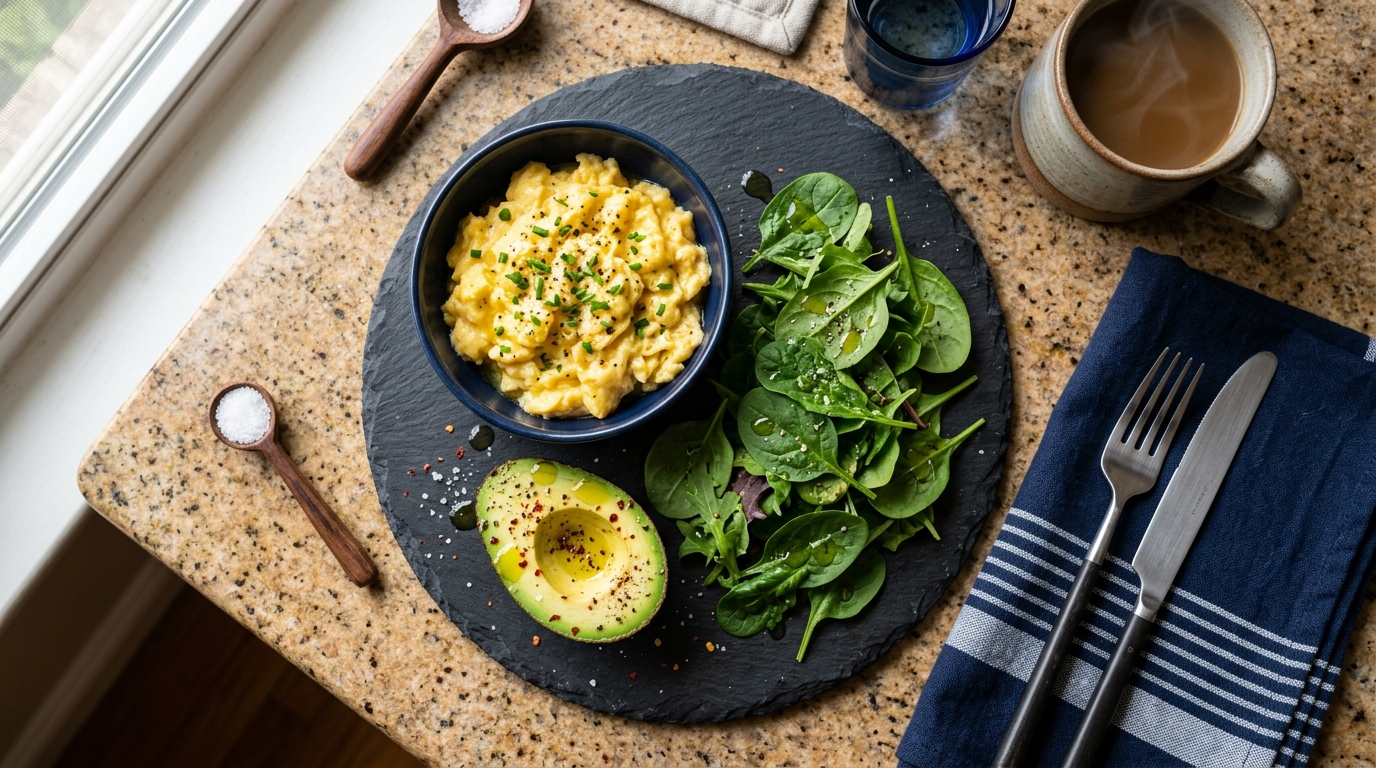
Example 1: The Egg Plate - 3 eggs (fried, scrambled, or omelet) cooked in butter or olive oil - 1-2 cups sautéed vegetables (spinach, mushrooms, peppers, zucchini) - 1/2 avocado or 1 tablespoon olive oil - Salt and electrolytes (Celtic salt)
Breakdown: ~50g fat, ~18g protein, ~8g net carbs. This keeps insulin low and stable for 4-5 hours.
Example 2: The Fat-Forward Smoothie - 1 cup full-fat Greek yogurt (unsweetened) - 1/4 cup macadamia or MCT oil - 1 tablespoon almond butter - 1/4 cup blueberries - 1 scoop vanilla collagen peptides - Ice and unsweetened almond milk
Breakdown: ~45g fat, ~25g protein, ~10g net carbs. Creamy, satisfying, keeps you full until lunch.
Example 3: The Savory Meat & Vegetables - 4 oz salmon or bacon - 2 cups mixed vegetables (broccoli, cauliflower, bell peppers) - 1-2 tablespoons butter or olive oil for cooking - 1 cheese stick if desired
Breakdown: ~50g fat, ~30g protein, ~8g net carbs. High in omega-3s and micronutrients.
Example 4: The Creamy Coffee If you're short on time: - 2 cups black coffee - 2 tablespoons heavy cream or MCT oil - 1 scoop collagen peptides - Pinch of salt - Plus a side of scrambled eggs or leftover meat
Breakdown: ~35g fat, ~8g protein, ~2g net carbs. This buys you time to prepare a full breakfast later, or carries you until a more substantial brunch.
The Pine Needles vs. Logs Principle Applied to Breakfast
Remember the pine needles vs. logs metaphor?
Your standard "healthy" breakfast is pine needles: carbs that burn fast and hot. They spike your blood sugar and insulin rapidly. Your body gets a surge of energy and a surge of "store fat" signaling from insulin. Then you crash.
The hormone-balancing breakfast is logs: fat that burns slowly and steadily. It sustains energy for hours. Insulin stays low and stable. Your body gets a permission signal to use stored fat, not store more.
The difference shows up in how you feel.
With pine needles (high-carb breakfast): You feel energized for 60-90 minutes, then crash hard. You need another hit of carbs to feel better.
With logs (high-fat breakfast): You feel steady, focused, and satisfied for 4-5 hours. No crash. No desperate hunger at 10 a.m.
This isn't about willpower or enjoying food less. It's about a fuel source that actually sustains you.
Common Objections (Addressed)
"Won't eating all that fat make me fat?"
No. Fat doesn't make you fat. Insulin makes you fat. When insulin is high, your body stores fat and can't access it. When insulin is low (which happens when you eat fat instead of carbs), your body can access stored fat for fuel. Additionally, fat is satiating—you feel full on less total food, so total calories naturally decrease. This isn't restriction; it's satisfaction.
"Isn't eggs/bacon/full-fat dairy bad for my heart?"
The research on this has shifted significantly. Saturated fat doesn't cause heart disease the way we once thought. What does drive heart disease: chronic high blood sugar, insulin resistance, inflammation, and oxidative stress. The hormone-balancing breakfast reduces these. If you have specific cholesterol concerns, discuss with your doctor, but don't automatically fear high-fat breakfast.
"What about my cholesterol?"
Dietary fat doesn't raise cholesterol the way refined carbs do. In fact, lowering carbs typically improves cholesterol ratios—raising HDL ("good" cholesterol) and improving your triglyceride-to-HDL ratio, which is a more meaningful marker than total cholesterol. Many women are shocked when their cholesterol panel improves after adopting a higher-fat breakfast.
"I'm vegetarian/vegan. What do I do?"
The principle is the same: high fat, moderate protein, low carbs. Examples: - Avocado, nuts, seeds, and full-fat plant-based protein (hemp seeds, pea protein) - Coconut yogurt with macadamia oil and seeds - Cauliflower hash fried in coconut oil with tahini - Full-fat tofu scramble cooked in olive oil with vegetables
The specific foods matter less than the macro ratio.
"Will I be hungry without carbs?"
Counterintuitively, no. Fat is far more satiating than carbs. When you eat fat and protein, your satiety hormones work properly. You naturally eat appropriate portions because you feel satisfied. This is one of the most common surprises women report: "I expected to be hungry, but I'm not."
The Breakfast That Changes Everything
Here's what I've seen repeatedly: women who make this one breakfast shift—from high-carb "healthy" to hormone-balancing high-fat—see disproportionate improvements across multiple symptoms:
- Energy stabilizes (no 10 a.m. crash)
- Brain fog lifts (steady fuel for your brain)
- Cravings decrease (stable blood sugar means stable appetite)
- Mood improves (consistent energy and less blood sugar volatility)
- Weight starts to shift (low insulin means body can finally access stored fat)
- Sleep improves (stable blood sugar through the day means better cortisol at night)
You don't have to wait for a program or a protocol. You can make this shift tomorrow morning. And the difference you notice will be real.
Breakfast is the meal that sets your metabolic tone for the day. If your first meal of the day is a blood sugar spike followed by a crash, you're chasing your tail all day. If your first meal is stable fat and protein, you're building momentum toward hormonal balance.
Ready to rebuild your entire metabolic day, starting with breakfast? Our free 5-Day Metabolic Challenge walks you through the why and the how of eating for hormonal balance. You'll learn not just what to eat, but why it works—so you can make choices that feel empowering, not restrictive.
In five days, you'll experience the energy, clarity, and satisfaction that comes from eating for your hormones instead of against them.
Latest Articles
Quick reads for steadier days.