Why Calorie Counting Stops Working After 40

Why Calorie Counting Stops Working After 40
You did it perfectly. You tracked every bite. You hit your 1,500-calorie target. You moved your body. You followed the rules.
And nothing changed.
The scale didn't budge. Your energy crashed. You felt deprived and irritable. And somehow, you feel slower, not faster.
By Friday you were eating everything you'd been "allowed" to deprive yourself of all week.
If this is your experience, I want you to know: you're not failing at the calories-in/calories-out model. The calories-in/calories-out model is failing you.
And it's not your fault. It's chemistry.
The Calorie Model Assumes Static Biology
The calorie model is beautifully simple: calories in, calories out. Eat less, move more, lose weight. It's a physics equation.
But your body isn't a machine that burns calories like a furnace burns fuel. Your body is a biological system where hormones decide what gets stored and what gets burned.
In your 20s and 30s, when your estrogen and progesterone were stable and your insulin sensitivity was intact, the calorie model kind of worked. Eat less, and your body burned more fat to make up the difference. It was relatively straightforward.
But in perimenopause, everything changes.
What Happens to Calories in Perimenopause
Here's the shift: 1,500 calories of food does not create the same metabolic outcome in a perimenopausal woman as it does in a 30-year-old woman.
Why? Because insulin is the traffic controller of your metabolism.
When insulin is low, your body can access stored fat and burn it for fuel. When insulin is high, your body stores excess energy as fat and holds onto it fiercely.
In perimenopause, your insulin sensitivity drops. That means the same amount of carbohydrate (which triggers insulin) now causes a higher insulin response. And high insulin means: store fat, hold onto fat, don't touch the fat stores.
You can eat fewer calories. But if those calories trigger a high insulin response, your body will still prioritize fat storage over fat burning.
The same 1,500 calories now cause more insulin elevation. More insulin = fat storing mode. Fat storing mode = weight loss resistance.
You're not eating too much. You're eating in a way that keeps your insulin too high.
The Deeper Cost of Calorie Restriction
This is where it gets harder. Severe calorie restriction doesn't just feel miserable — it actually worsens the problem.
When you dramatically reduce calories, your body senses scarcity. It releases more cortisol (your stress hormone) to help you find energy. Cortisol spikes. Your already-dysregulated blood sugar gets more dysregulated. Your insulin goes higher. Your metabolism — which was already slowing — slows further.
You're also likely cutting fat (because fat is calorie-dense and easy to reduce). But fat is exactly what you need to keep insulin stable. By cutting fat, you're making the insulin problem worse.
So you're catching yourself in a metabolic trap:
Calorie restriction → Cortisol elevation → Worse blood sugar dysregulation → Higher insulin → More fat storage resistance → Slower metabolism → More fatigue.
And then Friday comes, and you can't stay in the deficit because your body (rightly) is screaming for fuel and stable blood sugar.
You're not undisciplined. You're biochemically fighting a losing battle.
What Actually Works: Chemistry Over Willpower
The answer isn't fewer calories. It's fixing the insulin signal.
When you stabilize your blood sugar and lower your insulin, your body naturally stops driving fat storage. Your cells can access stored fat again. Your energy stabilizes. Your cravings disappear. You don't have to white-knuckle your way through the day.
This doesn't mean calories don't matter. But it means calories matter because of how they affect insulin, not instead of it.
A 1,500-calorie diet heavy in refined carbs (which spikes insulin) will store more as fat than a 1,800-calorie diet heavy in fat and protein (which keeps insulin stable).
The difference isn't willpower. It's the metabolic impact of what you're eating.
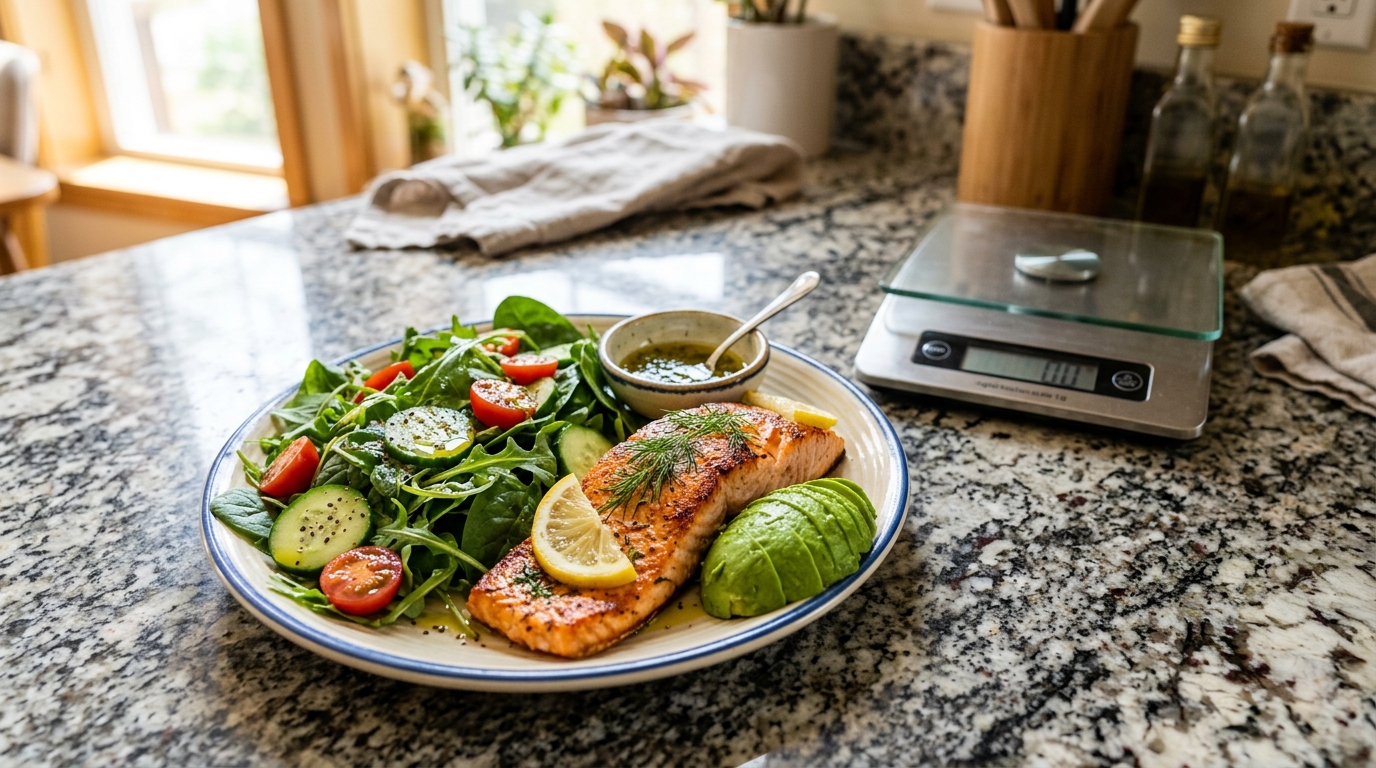
In the Bespoke Metabolic Method, we don't count calories. We count carbs — specifically net carbs. We focus on keeping your macros at 70% fat, 20% protein, and 10% carbs (under 25g net carbs) because this ratio keeps insulin as low as possible while providing complete nutrition.
At this ratio, your body shifts into fat-burning mode. Your insulin drops. Your cells regain access to your stored fat. Your energy stabilizes. You naturally eat less because your blood sugar is stable and your hormones aren't driving cravings.
And — this matters — you're not suffering. You're eating satisfying, nourishing food. You're not hungry. You're not exhausted.
The Real Answer
If you've been struggling with the calorie model, if you've felt like you're failing when actually you've been working against impossible biochemistry — I want you to know something:
You're not broken. The model is incomplete.
Your body needs an approach that works with your hormones, not against them. That means stabilizing insulin. That means nourishing your body with the macronutrients that support hormonal health. That means understanding that at 40+, your metabolism works differently, and that's not a failure — that's just biology.
The relief comes when you stop fighting your hormones and start working with them.
Ready to move beyond calorie counting? Join our free 5-Day Metabolic Challenge to learn how to eat in a way that stabilizes your blood sugar, lowers your insulin, and finally lets your body burn fat again. No counting. No deprivation. Just chemistry that works. Get the free challenge.
Latest Articles
Quick reads for steadier days.