Rhodiola for Energy and Focus in Perimenopause

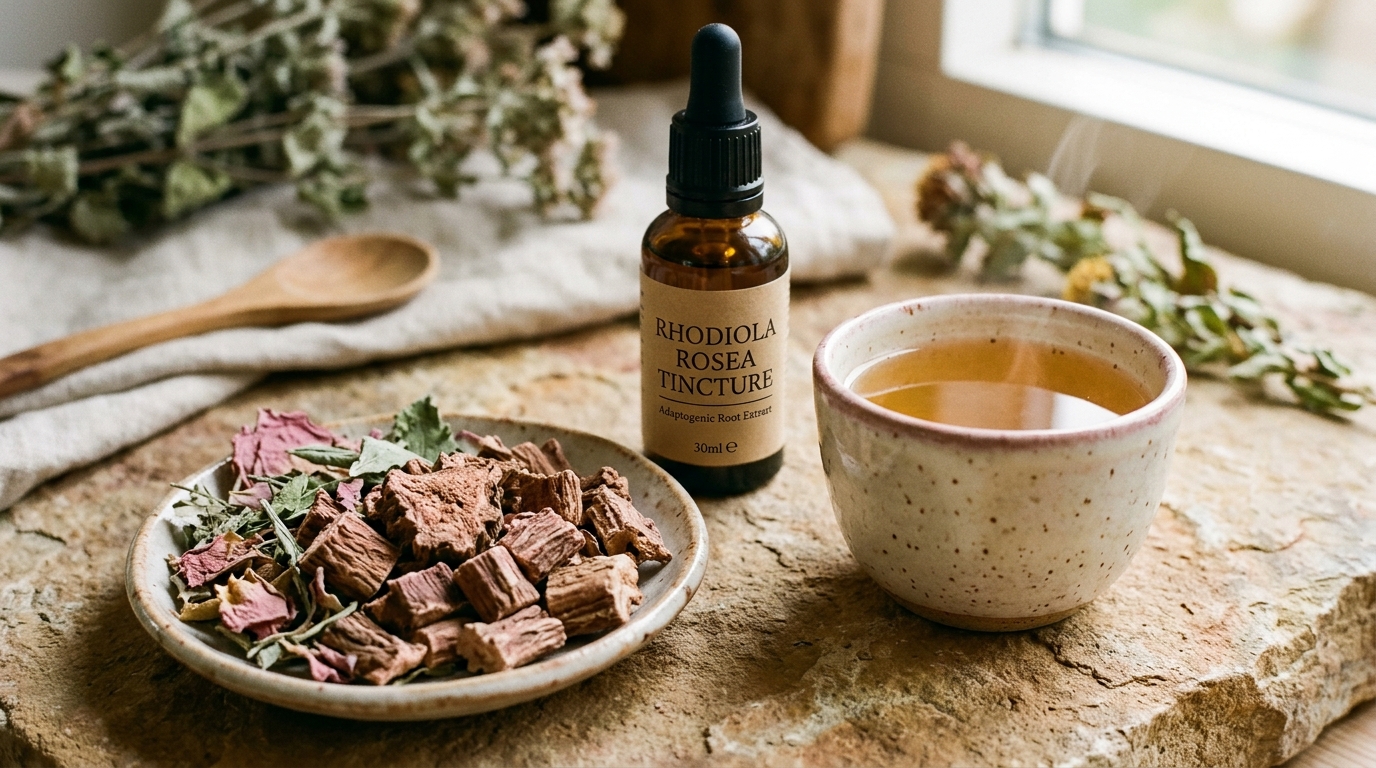
Rhodiola for Energy and Focus in Perimenopause
You're sitting at your desk at 2 p.m. Your eyes are heavy. Your thoughts feel sluggish. You've had coffee, you've had water, you've taken a walk. And still—nothing. The afternoon crash is relentless.
You're not lazy. You're not broken. You're in perimenopause, and your mitochondria—the power plants inside your cells—are struggling to keep up with the demands of your changing hormones and metabolism.
There's an adaptogen that can help. It won't solve perimenopause. But it can significantly shift your energy, focus, and resilience.
It's called rhodiola rosea.
What Rhodiola Actually Does
Rhodiola is a "stimulating adaptogen"—an herb that helps your body adapt to stress while increasing energy and mental function. Unlike stimulants (like caffeine, which forces your nervous system to work harder), rhodiola supports your nervous system's actual capacity.
It works through multiple pathways:
Neurotransmitter balance: Rhodiola increases serotonin, norepinephrine, and dopamine—the neurotransmitters that control mood, motivation, focus, and drive. In perimenopause, when estrogen fluctuations destabilize these neurotransmitters, rhodiola brings balance.
Cortisol normalization: Rhodiola helps regulate cortisol (your stress hormone) by supporting your HPA axis (hypothalamic-pituitary-adrenal). It dampens the morning cortisol spike if you wake in panic, and supports healthy afternoon decline. This matters because elevated cortisol impairs mitochondrial function and worsens energy crashes.
Mitochondrial support: Rhodiola enhances mitochondrial ATP production—the actual energy currency in your cells. More ATP = more available energy. This is why women report not just "feeling awake," but actually having energy to do things.
Neuroprotection: Rhodiola increases antioxidant enzymes in the brain, protecting against oxidative stress. It may promote BDNF (brain-derived neurotrophic factor), which supports neurogenesis and brain plasticity—your brain's ability to adapt and form new connections.
Mood and motivation: Dysphoria and apathy are common in perimenopause. Rhodiola directly addresses these by supporting dopamine and norepinephrine (motivation and drive). Many women report that they stop feeling like they're dragging through life and start feeling engaged again.
The result isn't a caffeine jolt. It's a deeper, more sustainable shift in your baseline energy and cognitive capacity.
The Research Picture
Rhodiola has been studied extensively in athletes, stressed professionals, and people with depression and fatigue. The findings are consistent:
- Improves mental and physical performance under stress
- Reduces fatigue and enhances endurance
- Improves mood and reduces anxiety and depression
- Enhances concentration and memory
- Supports sleep quality (yes, an energizing adaptogen that also supports sleep—this is the paradox of true adaptogens)
Most studies use standardized extracts containing at least 3% rosavins and 1% salidroside (the active compounds). Quality matters. Not all rhodiola is created equal.
For women specifically, there's growing evidence that rhodiola helps with perimenopausal symptoms—fatigue, mood swings, cognitive changes.
How to Use Rhodiola
Dosing
Start low and build gradually. This isn't because rhodiola is dangerous, but because your nervous system needs time to adjust.
Week 1: 150mg daily, taken in the early morning with food Week 2-3: 150mg twice daily (morning and midday, if needed) Maintenance: 150-300mg daily for 3-4 weeks, then assess
Maximum dose: 600mg daily (usually 300-400mg is ideal for most women)
Don't exceed 600mg daily without professional guidance.
Timing
Take rhodiola in the early morning or early afternoon—not after 3 p.m. It's stimulating. Taking it late will interfere with sleep, defeating the purpose.
Many women take it first thing in the morning with breakfast, then optionally a second dose at noon if afternoon energy crashes.
Duration
Rhodiola works best with consistent use over 2-4 weeks. You might feel subtle shifts within days, but the real benefits emerge at the 3-4 week mark as it accumulates in your system and cortisol patterns genuinely shift.
Use it for 8-12 weeks, then take a 2-week break. This prevents tolerance and keeps your nervous system responsive.
Don't use year-round. Adaptogens work best with periodization (on, then off). Your nervous system needs to practice its own resilience.
What to Expect
Week 1-2: Subtle. You might notice slightly less heaviness in the afternoon, or that 2 p.m. fog feels a touch lighter. Some women feel nothing and worry it's not working. It's working—it's just subtle.
Week 2-3: More noticeable. Your energy feels steadier. You're not riding the dramatic afternoon crash. Your focus feels clearer. Mood is lighter.
Week 4+: Significant. The difference is unmistakable. You have energy through the afternoon. You can focus for hours without mental fog. Your mood is more even. Motivation returns.
Sleep: Often improves paradoxically. Because stress hormones are normalized, you sleep better despite "taking a stimulant." Many women report falling asleep more easily and waking more refreshed.
Important Cautions
Rhodiola is safe for most women, but there are interactions and contraindications:
Avoid if you: - Are taking MAOIs (monoamine oxidase inhibitors—older antidepressants) - Are taking SSRIs or other serotonergic medications (risk of serotonin syndrome, though rare; discuss with your doctor) - Are immunosuppressed or taking immunosuppressants - Have bipolar disorder or a personal/family history of mania (stimulating adaptogens can trigger mania in susceptible people) - Are pregnant or breastfeeding
Be cautious if you: - Have anxiety disorders (rhodiola can increase anxiety in some people; start very low, monitor closely) - Are sensitive to stimulants - Have high blood pressure (though studies show it normalizes BP, start conservatively)
Always: - Tell your doctor or naturopath you're taking it, especially if you're on medications - Buy from a reputable source (third-party testing matters—heavy metals and contaminants are a risk with herbal supplements) - Start low and go slow
Quality Matters
Not all rhodiola supplements are equal. Many are weakly standardized or adulterated.
Look for: - Standardized extract (minimum 3% rosavins, 1% salidroside) - Third-party tested (NSF, USP, or ConsumerLab verified) - Reputable brands (Gaia Herbs, Herb Pharm, Thorne, and similar are generally good) - Avoid bulk powder unless you trust the source
A quality rhodiola supplement costs $15-30 per month. It's worth it.
Rhodiola + Metabolic Repair
Rhodiola pairs beautifully with the metabolic approach (70/20/10 macros, low insulin, stable blood sugar).
Here's why: when your blood sugar is stable, your cortisol is more stable. When cortisol is stable, your mitochondria function better. When mitochondria function better, you have energy. Rhodiola amplifies this.
You're not using rhodiola to "fix" poor metabolism or substitute for metabolic repair. You're using it to support your nervous system while you repair your metabolism.
Together, they're more powerful than either alone.
One More Thing: This Isn't a Substitute
Rhodiola won't: - Fix perimenopause symptoms permanently - Replace sleep or stress management - Undo poor nutrition - Solve hormonal chaos
What it will do is give you the energy and mental clarity to do the work—to stick with metabolic repair, to manage stress more effectively, to sleep better, to make better choices.
It's not magic. It's support.
Your Energy Is Waiting
One of the most powerful conversations I have with women is in Week 4 of rhodiola + metabolic repair, when they tell me:
"I forgot what it felt like to have energy. I forgot what it felt like to want to do things. I thought this was just aging. It's not. I'm me again."
That shift—from dragging through life to living with agency and energy—is profound.
Perimenopause doesn't have to mean permanent exhaustion. A combination of metabolic repair and strategic supplementation can restore your vitality.
Your Next Step
If afternoon energy crashes, brain fog, and low motivation are defining your perimenopause, it's worth exploring. Talk to your doctor or naturopath. Start low. Give it 4 weeks. Notice what shifts.
And pair it with metabolic repair—the 70/20/10 approach that stabilizes your blood sugar and supports your mitochondrial function at the foundation.
I've built the 5-Day Metabolic Challenge to give you the full framework: how to eat for stable energy, why certain nutrients matter, and how metabolic repair restores your vitality naturally.
[Join the Free 5-Day Metabolic Challenge]
Your energy is still there. Sometimes it just needs support to resurface.
Let's bring it back.
Latest Articles
Quick reads for steadier days.