Insulin Resistance in Perimenopause: The Complete Guide

Insulin Resistance in Perimenopause: The Complete Guide
Insulin is your body's traffic controller.
When insulin is working properly, it directs nutrients exactly where they need to go: glucose into your muscles and brain for energy, excess glucose into storage as glycogen, fat into your cells to be burned or stored as needed. Everything flows smoothly. You feel energized. You're not constantly hungry. Your hormones are balanced. Weight stays stable.
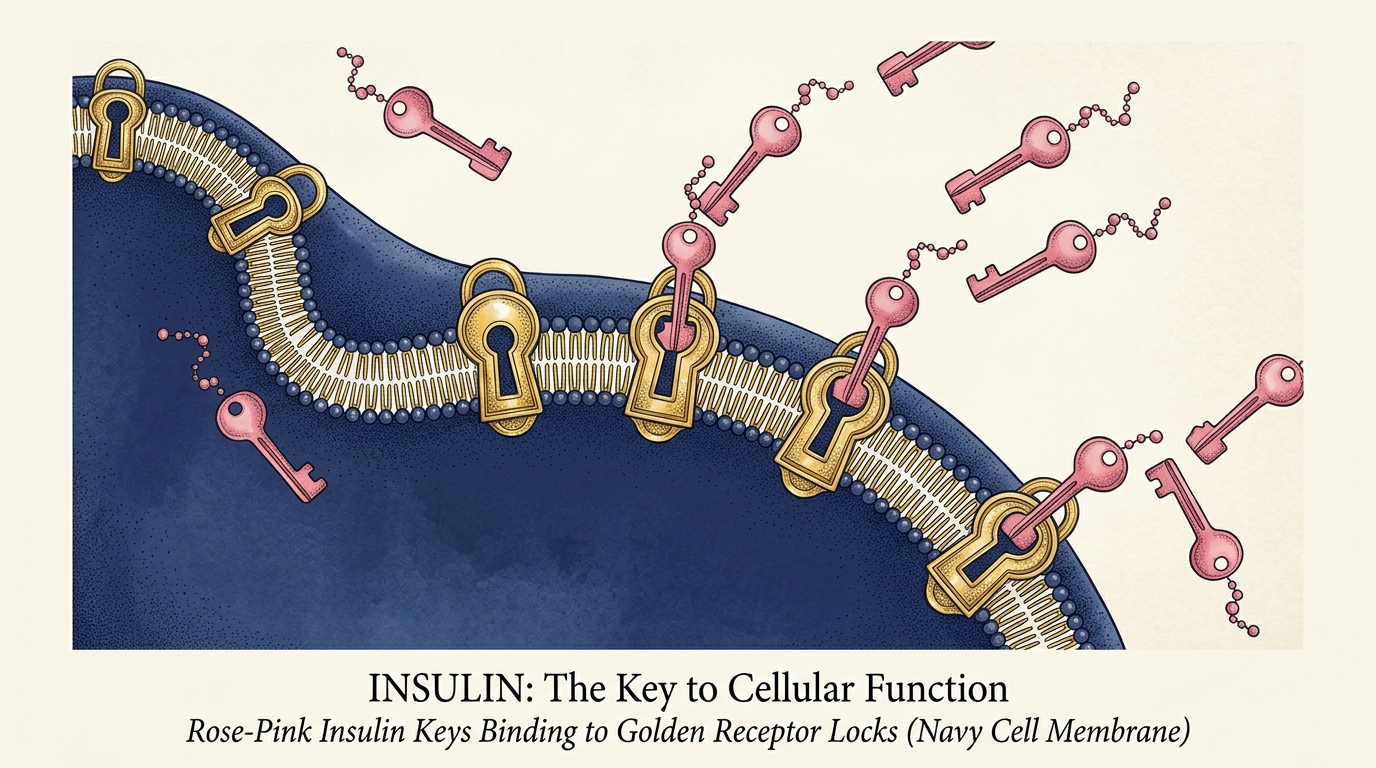
But when your cells stop listening to insulin—when they become insulin resistant—traffic backs up everywhere.
Insulin can't direct glucose efficiently, so your pancreas makes more insulin, trying harder to force the message through. Your cells stay resistant. Glucose piles up. Insulin stays chronically high. And your body, drowning in high insulin, shifts into storage mode: store fat, preserve fat, don't you dare access your own fat for energy.
This is insulin resistance. And in perimenopause, it's the metabolic disaster hiding behind almost every symptom you're experiencing.
What Is Insulin Resistance?
Insulin is a hormone your pancreas makes in response to food, especially carbohydrates.
Here's the normal flow: 1. You eat carbs 2. Glucose enters your bloodstream 3. Insulin is released 4. Insulin tells your cells, "Open up, accept this glucose" 5. Your cells respond: "Yes, we'll take it" 6. Glucose is taken up, blood glucose returns to normal 7. Insulin drops 8. Everything is fine
Here's the insulin resistance flow: 1. You eat carbs 2. Glucose enters your bloodstream 3. Insulin is released 4. Insulin tells your cells, "Open up, accept this glucose" 5. Your cells don't respond: "We're not listening. You need to make more insulin." 6. Your pancreas gets the message: "Make MORE insulin" 7. More insulin is released, at higher and higher levels 8. Your cells eventually take up some glucose, but the effort and the insulin levels are escalating 9. Your blood stays chronically elevated in insulin, even when you're not eating 10. High insulin tells your fat cells: "STORE. Do not release."
And that's where you're stuck. Chronically high insulin. Fat cells locked in storage mode. Your body unable to access its own fuel. Constant hunger. Impossible weight loss. Mood disruption. Fatigue. Hot flashes. Brain fog.
This is insulin resistance.
Why Does Perimenopause Trigger Insulin Resistance?
Insulin sensitivity depends heavily on estrogen and progesterone.
In your 20s and 30s, when estrogen and progesterone are stable and abundant, your cells listen to insulin beautifully. You can eat normally. Your metabolism hums. Weight management is relatively easy.
In perimenopause, everything destabilizes:
- Estrogen fluctuates wildly — High one day, crashing the next. This chaos affects how your cells respond to insulin.
- Progesterone drops dramatically — Progesterone actually improves insulin sensitivity. When it drops, your cells become more resistant.
- Cortisol dysregulation — The stress of hormone fluctuations keeps cortisol elevated. High cortisol impairs insulin sensitivity and promotes insulin resistance.
- Inflammation increases — Fluctuating hormones trigger inflammation, and inflammation directly causes insulin resistance.
Additionally, many women in perimenopause have been undereating, overexercising, or dieting for decades. This chronic metabolic stress can actually cause insulin resistance. Your body becomes protective. "You never give me enough food. I'm going to hold onto every bit of fat I can." Your insulin resistance gets worse.
So perimenopause doesn't just trigger insulin resistance—it's a perfect storm of hormone chaos, inflammation, and years of metabolic stress colliding all at once.
How to Know If You Have Insulin Resistance
You can't see insulin resistance. But you can measure it.
The Fasting Insulin Test
This is the gold standard. You fast overnight, then have your fasting insulin level checked.
- Normal: Under 10 mIU/L
- Mild insulin resistance: 10–15 mIU/L
- Moderate-to-severe: Above 15 mIU/L
Many doctors don't order this test. Ask for it specifically.
The Triglyceride-to-HDL Ratio
Get a standard lipid panel and calculate this yourself:
Triglycerides ÷ HDL cholesterol = ratio
- Healthy: Below 2
- Insulin resistant: Above 3–4
This is a powerful predictor of insulin resistance.
Fasting Glucose
- Normal: Below 5.6 mmol/L
- Prediabetic range: 5.6–6.9 mmol/L
- Diabetic range: Above 7 mmol/L
But here's the catch: you can have normal fasting glucose and still have insulin resistance. The glucose is normal because your insulin is working overtime to keep it down.
Waist-to-Height Ratio
This is more predictive than BMI:
Waist circumference (in inches) ÷ Height (in inches)
- Healthy: Below 0.5
- Metabolic risk: Above 0.53
If your waist is getting bigger even though your weight isn't changing much, that's visceral fat accumulation—classic insulin resistance.
The Symptoms
These are the real-world signs of insulin resistance:
- Constant hunger — High insulin tells your brain, "You're starving." You eat, insulin spikes, hunger briefly quiets, then high insulin creates another hunger signal.
- Weight gain, especially around the middle — High insulin directs fat storage to your belly and visceral organs.
- Energy crashes — Your blood glucose is bouncing around. Spikes and crashes = energy crashes.
- Mood swings, irritability, anxiety — Blood sugar instability dysregulates neurotransmitters.
- Brain fog, difficulty concentrating — Your brain needs stable glucose. Bouncing glucose = foggy brain.
- Intense cravings for carbs or sugar — When blood glucose crashes, your body screams for quick energy: sugar, bread, pasta.
- Sleep disruption — Unstable blood glucose keeps you alert at night.
- Heavy or irregular periods — High insulin disrupts hormone balance.
- Acne or skin issues — Insulin triggers androgens, which affect skin.
- Difficulty losing weight — High insulin locks fat in storage mode.
If you recognize yourself in multiple symptoms, you likely have insulin resistance.
How to Reverse Insulin Resistance
The good news: insulin resistance is completely reversible. It's not a life sentence. It's a signal your body is sending: "Change the conditions, and I'll heal."
Here's how to change the conditions:
1. Lower Your Carbohydrate Intake (Dramatically)
This is the most powerful intervention. When you eat fewer carbs—especially processed carbs and refined carbs—your blood glucose doesn't spike. Your pancreas doesn't need to make as much insulin. Insulin levels drop.
The target: Under 25g net carbs daily (carbs minus fiber).
This isn't forever. It's the repair phase. Once your insulin sensitivity is restored, you can eat more carbs. But in this phase, you're starving the fire.
2. Eat Plenty of Healthy Fats
Fats don't spike insulin. They keep you satisfied. They support your cell membranes and hormone production.
The target: 70% of your calories from fat (mostly unsaturated fats: olive oil, avocado oil, nuts, fatty fish; some saturated fats: ghee, coconut oil, grass-fed butter).
3. Prioritize Quality Protein
Protein supports muscle (which is metabolically active), regulates appetite hormones, and doesn't spike insulin.
The target: 20% of your calories from protein (roughly 25–35g per meal).
4. Support Your Electrolytes
When you eat fewer carbs, your kidneys excrete more sodium. Low sodium = low energy, more cravings, more blood sugar crashes. This is why people fail at low-carb diets: they get depleted.
- Celtic or Himalayan salt generously on your food
- Magnesium glycinate 200–400mg daily (supports blood sugar, nerves, sleep)
- Potassium from vegetables and broth
Adequate electrolytes = smooth transition = success.
5. Measure Your Metabolic Progress
Use your Glucose Ketone Index (GKI) to track your insulin repair:
GKI = Blood glucose (mmol/L) ÷ Blood ketones (mmol/L)
- GKI 1–3: Deep repair
- GKI 3–6: Insulin signal repair (where most metabolic work happens)
- GKI 6–9: Sustainable fat loss
Testing your GKI weekly tells you objectively: "Is my insulin coming down? Is my metabolic signal repairing?"
6. Reduce Stress & Improve Sleep
High cortisol (from stress and poor sleep) directly promotes insulin resistance. Aim for:
- 7–9 hours of sleep
- Stress management: walking, breathing, meditation
- Regular movement: not punishing exercise, but gentle consistent activity
7. Give It Time
Insulin resistance took years to develop. Reversing it takes weeks to months, not days.
- Week 1–2: Your blood glucose starts stabilizing. Hunger begins to settle.
- Week 2–4: Your insulin drops noticeably (visible on your GKI). Energy returns.
- Month 1–3: Your metabolic signal is significantly repaired. Weight loss becomes effortless. Hormones stabilize.
- Month 3+: Your insulin sensitivity is restored. You can test adding more carbs while staying stable.
What Changes When Insulin Resistance Is Reversed
When you fix your insulin resistance, everything else gets easier:
- Weight loss becomes effortless — Your body finally has access to its own fat stores
- Hunger settles — You're no longer driven by blood sugar crashes
- Energy returns — Stable glucose = stable energy
- Hormones stabilize — Lower insulin = better estrogen/progesterone balance = fewer mood swings, better periods
- Hot flashes diminish — Stable blood sugar = less vasomotor disruption
- Brain fog clears — Your brain gets stable fuel
- Sleep improves — Stable blood glucose = restful sleep
- Cravings vanish — No more intense sugar/carb cravings
This is the cascade of healing that happens when you address the root: insulin resistance.
The Bespoke Metabolic Method Approach
In The Bespoke Metabolic Method, we use a 9-week protocol specifically designed to reverse insulin resistance in perimenopause:
- Phase 0: Foundation — Understanding your metabolic baseline
- Phase 1: Fix the signal — Lower carbs, raise fats, stabilize insulin
- Phase 2: Cellular repair — Deeper metabolic healing, supporting your cells
- Phase 3: Real-world living — Expanding your macronutrients while maintaining metabolic resilience
You're not white-knuckling through a diet. You're learning the chemistry, measuring your progress with your GKI, and watching your insulin resistance reverse.
The Path Forward
Insulin resistance is fixable. It's not your fault. It's not a character flaw. It's a signal that your metabolic conditions need to change.
Change the conditions—lower carbs, raise healthy fats, stabilize your blood glucose, support your electrolytes—and your body will heal.
Ready to reverse your insulin resistance and reclaim your metabolic health? Join the free 5-Day Metabolic Challenge and get the complete roadmap: testing, macronutrients, electrolytes, and metabolic tracking. Watch your insulin levels drop, your energy return, and your weight become effortless. This is how metabolic repair actually works.
Dr. Kimberly Boileau, ND, specializes in reversing insulin resistance in women 38-52 in perimenopause. The Bespoke Metabolic Method is a 9-week program designed to repair your metabolic signal and give you back your energy, hormones, and effortless weight loss.
Latest Articles
Quick reads for steadier days.