The Hormone-Balancing Plate: 70/20/10 Explained

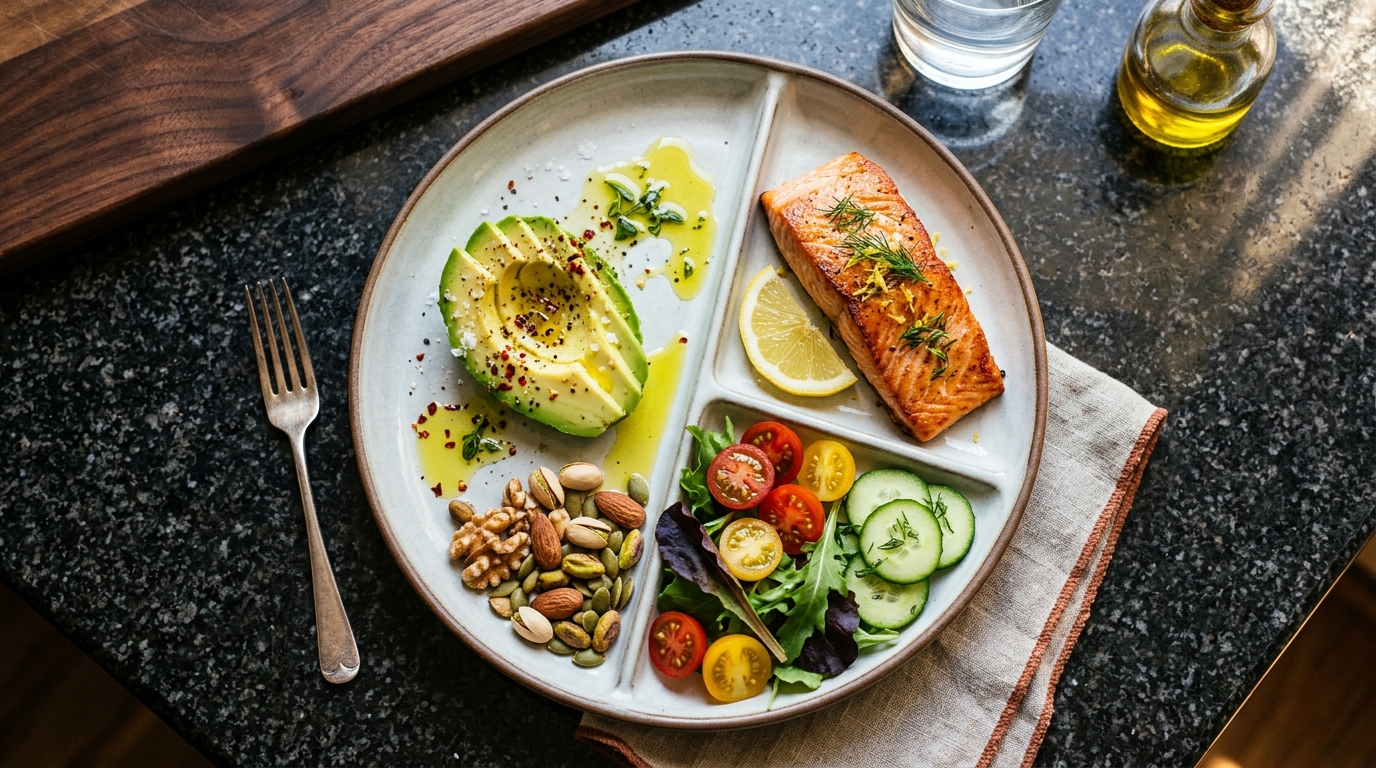
The Hormone-Balancing Plate: 70/20/10 Explained
There's a moment in my work with women when it clicks. They stop thinking about calories, counting macros obsessively, or wondering if they're "doing it right."
They just look at a plate and think: Healthy fat, protein, vegetables. That's what I need.
The shift from confusion to clarity happens when you understand the 70/20/10 macro ratio—not as a rigid rule, but as a framework that keeps your insulin low and your metabolism working.
Let me walk you through exactly what this looks like in practice.
The 70/20/10 Framework
This isn't complicated, but it's precise:
- 70% calories from fat (primarily healthy, unsaturated and saturated fats from whole foods)
- 20% calories from protein (about 0.8-1g per pound of body weight, adjusted for activity)
- 10% calories from carbohydrates (net carbs under 25g daily)
This ratio does one thing: it keeps insulin low. Low insulin = fat-burning, reduced hunger, metabolic clarity.
This isn't "bro keto" (all meat, no vegetables). This isn't a fad. This is therapeutic macronutrient composition designed to address insulin resistance in women's midlife.
The Proteins (20%)
Protein serves multiple roles: satiety, muscle preservation, neurotransmitter synthesis, and structural repair. You're targeting roughly 100-120g daily (adjusted for your weight and activity level).
The best sources:
- Eggs: 6g protein per egg. Budget-friendly, nutrient-dense (choline for brain, lutein for eyes). Eat the whole egg—the yolk has the nutrients.
- Fish: 6-7g protein per ounce. Salmon and sardines provide omega-3 fats (anti-inflammatory). Eat them 2-3x weekly.
- Poultry: Chicken and turkey, 7g protein per ounce. Lean and reliable. Skin-on and thighs are tastier and more nourishing than skinless breasts.
- Grass-fed meat: Beef, lamb, pork. 7g protein per ounce. Grass-fed has better omega-3:omega-6 ratio than grain-fed. Worth the cost.
- Greek yogurt: 15-20g protein per cup. Use full-fat, minimal carbs (5-6g per cup), but don't overdo—it's easy to eat too much.
The portions:
Aim for 4-6 oz of protein per meal (palm-sized portion). That's roughly 25-35g protein per meal. Across 3 meals, you'll hit your daily target.
Don't overthink it. A palm-sized portion of fish or meat, two eggs, or a Greek yogurt portion. That's your protein target per meal.
The Fats (70%)
This is where most of the calories come from. And this is where the nutrition lives. Fats carry fat-soluble vitamins (A, D, E, K). Fats build cell membranes. Fats are required for hormone synthesis.
The goal is 100-150g of fat daily (adjusted for your total calories and activity level).
The best sources:
- Avocado: 20g fat per whole avocado (net 2g carbs). Potassium, folate, fiber. Eat half an avocado with every meal, or a whole one daily.
- Olive oil: 10g fat per tablespoon. Highest in polyphenols (antioxidants) when extra virgin. Use for salads and finishing dishes. Don't cook with it (low smoke point).
- Nuts: Macadamia (12g fat, 2g carbs per oz), almonds (14g fat, 3g carbs per oz), pecans (20g fat, 4g carbs per oz). Small handful is roughly 1 oz.
- Seeds: Chia, flax, pumpkin. 5-10g fat per tablespoon, plus fiber. Sprinkle on salads or eat as snacks.
- Coconut oil: 14g fat per tablespoon. Medium-chain triglycerides (MCTs) may enhance ketone production. Higher smoke point, good for cooking.
- Ghee or grass-fed butter: 12g fat per tablespoon. Rich, flavorful, supports absorption of fat-soluble vitamins. Use for cooking or finishing dishes.
- Fatty fish: Salmon, sardines, mackerel. Omega-3 fats (anti-inflammatory). 6-7g fat per ounce.
- Full-fat dairy: Cheese, full-fat Greek yogurt, cream (in moderation). Nutrient-dense.
- Egg yolks: 5g fat per yolk, plus choline. Don't throw them away.
The portions:
This is where clarity helps: fats are calorically dense. You don't need huge portions.
Per meal, target 20-30g of fat: - Avocado (half): 12g - Olive oil (1 tbsp): 10g - Nuts (small handful): 12g - Cheese (1 oz): 9g - Salmon (3 oz): 9g
You can build a satisfying, nutrient-dense meal with these portions.
The Carbohydrates (10%)
Here's where this differs from what you've been told. You're not cutting carbs to zero. You're cutting them to therapeutic levels (net carbs under 25g daily). This keeps insulin low without creating deprivation or nutrient deficiency.
The best sources:
- Leafy greens: Spinach, arugula, mixed greens, kale. Virtually zero carbs, abundant micronutrients. Eat liberally.
- Cruciferous vegetables: Broccoli, cauliflower, Brussels sprouts, cabbage. 3-5g net carbs per cup, high in fiber, anti-inflammatory compounds. Eat 1-2 cups daily.
- Other low-carb vegetables: Zucchini, asparagus, green beans, cucumber, bell peppers. 2-4g net carbs per cup. Eat freely.
- Berries (small amounts): Raspberries (1g net carb per cup), blackberries (1g net carb per cup), blueberries (5g net carb per half cup). Use as garnish or small snack, not a main carb source.
- Starchy vegetables (occasional): Sweet potato, regular potato, squash. Not eliminated, but limited to special occasions or post-workout (if you're exercising intensely).
The portions:
Per meal, target 5-10g net carbs: - A large salad of mixed greens: 1-2g - 1 cup cooked broccoli: 4g - 1 medium zucchini, spiralized: 4g - Handful of raspberries: 1g
You can easily hit your daily carb target while eating abundant, satisfying vegetables.
Building a Hormone-Balancing Plate
Here's what a real meal looks like:
Breakfast: - 3 eggs (18g protein, 15g fat) - 1 tbsp ghee for cooking (14g fat) - 2 cups spinach, cooked in the eggs (1g carbs) - Pinch of Celtic sea salt - Macros: 18g protein, 29g fat, 1g carbs
Lunch: - 4 oz salmon (28g protein, 9g fat) - 1 tbsp olive oil on salad (10g fat) - 2 cups mixed greens (2g carbs) - Half an avocado on the salad (12g fat) - Cucumber slices (1g carbs) - Macros: 28g protein, 31g fat, 3g carbs
Dinner: - 4 oz grass-fed beef (28g protein, 12g fat) - 1 tbsp olive oil for cooking (10g fat) - 1 cup roasted broccoli (4g carbs, 3g fiber = 1g net carbs) - Small side salad with olive oil dressing (10g fat) - Salt and pepper - Macros: 28g protein, 32g fat, 1g carb
Daily total (example): ~100g protein, 92g fat, ~5g carbs
This is roughly the right ratio. Protein and carbs scale with your individual needs; fat remains the largest caloric component.
Why This Ratio Works
For insulin: Fats and protein trigger minimal insulin response. Carbohydrates spike it—but at under 25g net carbs daily, and distributed across meals, your blood glucose and insulin stay stable. Stable insulin = fat-burning, reduced hunger, metabolic repair.
For satiety: Fat is satiating. Protein is satiating. Together, they trigger fullness hormones (CCK, peptide YY) that keep you satisfied for 4-5 hours. You don't snack out of hunger; you snack out of habit or emotion.
For nutrients: This ratio prioritizes whole foods—eggs, fish, meat, avocado, nuts, vegetables. You're getting micronutrients naturally, not chasing a multivitamin.
For hormones: Fat is required for hormone synthesis. Adequate protein supports neurotransmitter production. The micronutrients (folate, magnesium, vitamin K) support methylation and estrogen metabolism. You're not starving your endocrine system.
For muscle: Adequate protein (with strength training) preserves muscle during fat loss. Muscle is metabolically active; you want to keep it.
The Flexibility
This framework isn't rigid. It's a target, not a law.
Some meals might be 60% fat, others 75%. Some days might land at 22g carbs, others at 28g. This isn't failure—it's being human.
The goal is consistency in direction: mostly staying in the 70/20/10 range, knowing that most of your meals hit this target, and that it supports your metabolic repair.
When you're eating out and the macro breakdown isn't perfect—one meal won't undo your repair. Your metabolic signal is more resilient than that.
Tracking (If You're That Type)
You don't have to count macros. Many women simply look at their plate and think: protein, fat, vegetables. That's enough.
If you like data, you can track with an app like Cronometer for a few weeks—not to obsess, but to learn what real portions look like. After 2-3 weeks of tracking, you develop intuition. You can eyeball it.
The goal is freedom, not obsession.
Your Plate, Your Signal
The 70/20/10 framework is powerful not because it's mystical, but because it's based on your metabolic physiology. It keeps insulin low. It supports nutrient density. It's sustainable.
And once you understand the framework, you stop wondering if you're "doing it right." You look at your plate, you see it's balanced, and you trust it.
That confidence matters. It means you're not eating in chaos, wondering if you should restrict more or eat more. You're eating with intention, understanding why.
Ready to Apply This?
If you want to dive deeper—to understand how to build these plates in your own kitchen, how to adjust for your individual needs, and how to transition sustainably into this way of eating—the 5-Day Metabolic Challenge walks you through it.
You'll get meal examples, macro breakdowns, and the science behind why this ratio resets your metabolism.
[Join the Free 5-Day Metabolic Challenge]
Your plate is your metabolic signal. Make it count.
Latest Articles
Quick reads for steadier days.